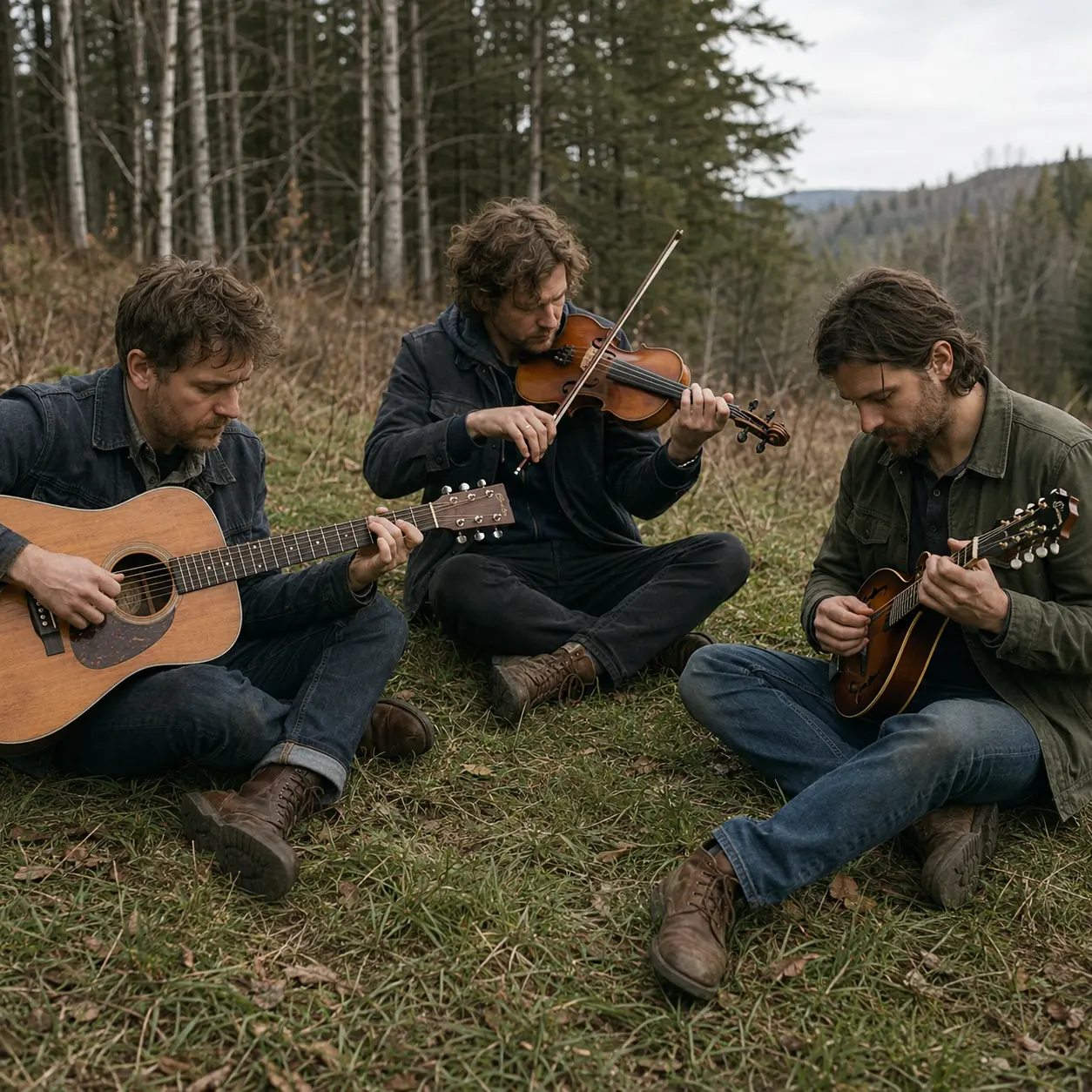
An arrangement is a set of decisions
A song can survive many arrangements. The melody, words and harmonic movement may remain, while everything around them changes: the pulse, the register, the amount of silence and the distance between a voice and the listener. Arrangement is the work of deciding what enters, what waits and what never needs to be added.
There is no single indie-folk formula. Folk Alliance International describes folk as a broad field shaped by communities, stories and many musical traditions rather than one approved set of instruments. That openness matters. An acoustic guitar can establish the centre of a track, but it does not make the track honest by itself. The relationship between the parts does.
The guitar can be clock, floor or weather
A repeating fingerpicked figure can act like a clock: small movements interlock and quietly tell the song where it is. Broad strumming behaves more like a floor, giving the voice and other instruments a stable surface. Long ringing strings can become weather, colouring the space without insisting on a separate melody.
The useful choice is not always the most impressive part. If the lyric carries the story, a pattern with fewer notes may leave the right openings. If the track is instrumental, the guitar may need more internal movement so that repetition feels steady rather than static. Listening for the role of a part is more revealing than counting how many notes it contains.
Where the voice sits changes the whole room
A close, nearly dry vocal can feel private, as if the singer has stepped into the listener’s immediate space. More room sound creates distance and scale. A doubled line can add weight, while a harmony can open a second emotional angle. None of these choices is automatically more natural than another; each changes the imagined room around the song.
Backing voices work best when they have a job. They might lift one phrase, answer the lead or mark the moment when a private thought becomes shared. If they remain at full strength everywhere, that change loses meaning. Restraint gives an entrance a reason to be noticed.
Small instruments should answer, not queue for attention
Violin, mandolin, cello, harmonica and light percussion can make an acoustic arrangement more distinctive, but not when every instrument speaks at once. A short violin line can finish a sentence left by the voice. A mandolin can brighten the upper register. A low bowed note can widen the ground beneath a chorus.
One practical principle is call and response: let a supporting part enter where the lead leaves space. Another is subtraction: when the vocal returns, remove or simplify something. These are not rules of the genre. They are ways of protecting attention so that the listener always knows what matters now.
Room sound is part of the arrangement
The character of an acoustic instrument is not fixed before recording begins. Shure’s recording guidance explains that microphone choice and placement strongly affect the captured sound. Its acoustic-guitar guide notes that moving toward the soundhole generally adds bass, while the area where neck and body meet can offer a balance of warmth and clarity.
That means space is not merely decoration added at the end. A close microphone reveals fingers, pick and breath. A more distant position allows more of the room to enter. Even when software later shapes the recording, the first decision about distance already changes how intimate, polished or open the performance feels.
Dynamics need somewhere to go
A chorus feels larger only in relation to what came before it. The change may come from stronger playing, a higher melody, a new harmony or simply one extra instrument. It can also come from removing layers before the chorus so that the return has room to expand.
Compression can reduce peaks and make the average level feel stronger, as Ableton’s reference manual explains. Used heavily, it can also narrow the contrast between quiet and loud—an editorial reason to treat it as one tool rather than a substitute for arrangement. The emotional arc is clearest when the performance, the number of parts and the production all point in the same direction.
A five-pass listening exercise
First, follow only the pulse: which instrument keeps time, and does it ever stop? Second, listen to the voice and notice whether it feels close, distant, single or layered. Third, trace one supporting instrument and ask whether it doubles, answers or contrasts with the lead.
On the fourth pass, listen to the space—the room, reverb and silence between sounds. On the fifth, map what changes between verse, chorus and any instrumental section. You do not need production vocabulary to hear an arrangement clearly. You only need to notice when your attention moves and what made it move.
Listening inside the Indie Folk Radio universe
The connected projects offer different doors into these questions: Deanarrow90 centres songs and acoustic storytelling; Lararrow brings another vocal identity; The Eraths emphasise a shared folk character; and Deanarrow90 Instrumentals lets melody, texture and pacing carry the experience without lyrics. These are listening descriptions, not claims about a fixed live-band lineup.
AI is part of this project’s music-production process. The useful listening question remains human and specific: what has the arrangement asked you to notice, and what has it deliberately left alone? Return to the radio, choose one track and try the five passes above. A familiar song may reveal a different shape.